
Career in the Air Compressor Industry
Our air compressor business might be considered similar to an automobile manufacturer, although on a much smaller scale. Like an automotive company, we design and manufacture complex products, market them through independent distributors under our own brand names, and support them with parts, service, and a warranty. Our products must also comply with numerous federal environmental, safety, and performance standards.
Building this business has required substantial long-term investment. We own and operate the production facilities where our compressors are manufactured. These plants contain sophisticated machining centers used to produce critical steel and cast iron components, along with specialized equipment for assembling, testing, and moving products through the manufacturing process.
The business depends on much more than machinery. Our administrative and technical employees use sophisticated computer systems, a modern ERP platform, and increasingly, artificial-intelligence tools to improve communication, decision-making, and productivity.
We also have considerable investments in inventory and trade receivables that must be financed. While our bank has helped with this funding, we have needed to routinely retain prior year profits in the business to support future growth. But in a small business, investment is often made in the face of high uncertainty and risk.
A manufacturing company also requires people with a wide range of skills. Our employees work in production, shipping and receiving, quality control, maintenance, safety and regulatory compliance, engineering, purchasing, production scheduling, marketing, graphic design, sales, product support, accounting, information technology, supervision, and executive management.
We have also depended on many outside business partners. Our distributors, suppliers, bank, insurance company, accountants, attorneys, and technology providers are a few of the key affiliates.
My own role has changed considerably over the decades. At age 28, I left IBM Corporation to join Saylor-Beall. I brought with me a BBA and an MBA from the University of Michigan, along with the benefit of IBM’s extensive business and computer training. However, I was still young and needed to understand a new industry and develop my personality. There was much to learn, not only about air compressors and manufacturing, but also about customers, employees, distributors, and finance, during a time period when change started to accelerate.
Building and sustaining the business has required decades of planning, keeping profit in the business, and hard work. Today, our air compressor operations consist of three business units operating through two corporations: Saylor-Beall Manufacturing Company and Sullivan-Palatek, Inc. Together, we manufacture reciprocating, stationary rotary-screw, and portable diesel-powered air compressors for a wide range of commercial and industrial applications.
Although some people may view us as a large company, we are small compared with most of our competitors, as they are divisions of major publicly traded or foreign-owned corporations. When I entered the industry, it included many small, family-owned manufacturers. Over time, most were acquired by larger companies, and in many cases production was moved overseas to reduce costs.
At the same time, manufacturing technology advanced rapidly. Remaining competitive required us to invest continually in modern production equipment, computer systems, product development, and employee training. The growth of the Internet brought another major change by making it possible for compressors to be marketed and sold directly through online retailers, altering the traditional relationship among manufacturers, distributors, and customers.
We chose a different strategy. I remembered at IBM, where we provided a total solution; we not only sold computer products, but we were better able to help the customers make the data centers work better. That value added made IBM indispensable. At the same time, the Michigan Business School taught the value of differentiation whereby, by combining quality and service, the customer’s total cost of ownership was reduced. This helped us avoid being seen as a commodity that was purchased merely on price. An end customer often needs compressed air to run a critical operation. If we get the focus on making that operation more reliable, the product price becomes less of an issue.
We have also maintained a two-step distribution model. We sell primarily through independent distributors, who then sell and support the products for the end customer. A capable distributor provides considerably more than the sale of an air compressor. The distributor evaluates the customer’s needs, recommends the proper equipment, integrates the compressor into the customer’s complete compressed-air system, and provides installation assistance, maintenance, parts, and local service.
This combination of American manufacturing, dependable products, knowledgeable distributors, and strong customer support has become central to our competitive strategy. It allows a relatively small, independently owned manufacturer to compete successfully against much larger global companies.
Career in the Air Compressor Industry
Although some people may view us as a large company, we are small compared with most of our competitors, as they are divisions of major publicly traded or foreign-owned corporations. When I entered the industry, it included many small, family-owned manufacturers. Over time, most were acquired by larger companies, and in many cases production was moved overseas to reduce costs.
At the same time, manufacturing technology advanced rapidly. Remaining competitive required us to invest continually in modern production equipment, computer systems, product development, and employee training. The growth of the Internet brought another major change by making it possible for compressors to be marketed and sold directly through online retailers, altering the traditional relationship among manufacturers, distributors, and customers.
We chose a different strategy. I remembered at IBM, where we provided a total solution; we not only sold computer products, but we were better able to help the customers make the data centers work better. That value added made IBM indispensable. At the same time, the Michigan Business School taught the value of differentiation whereby, by combining quality and service, the customer’s total cost of ownership was reduced. This helped us avoid being seen as a commodity that was purchased merely on price. An end customer often needs compressed air to run a critical operation. If we get the focus on making that operation more reliable, the product price becomes less of an issue.
We have also maintained a two-step distribution model. We sell primarily through independent distributors, who then sell and support the products for the end customer. A capable distributor provides considerably more than the sale of an air compressor. The distributor evaluates the customer’s needs, recommends the proper equipment, integrates the compressor into the customer’s complete compressed-air system, and provides installation assistance, maintenance, parts, and local service.
This combination of American manufacturing, dependable products, knowledgeable distributors, and strong customer support has become central to our competitive strategy. It allows a relatively small, independently owned manufacturer to compete successfully against much larger global companies.
Our air compressor business might be considered similar to an automobile manufacturer, although on a much smaller scale. Like an automotive company, we design and manufacture complex products, market them through independent distributors under our own brand names, and support them with parts, service, and a warranty. Our products must also comply with numerous federal environmental, safety, and performance standards.
Building this business has required substantial long-term investment. We own and operate the production facilities where our compressors are manufactured. These plants contain sophisticated machining centers used to produce critical steel and cast iron components, along with specialized equipment for assembling, testing, and moving products through the manufacturing process.
The business depends on much more than machinery. Our administrative and technical employees use sophisticated computer systems, a modern ERP platform, and increasingly, artificial-intelligence tools to improve communication, decision-making, and productivity.
We also have considerable investments in inventory and trade receivables that must be financed. While our bank has helped with this funding, we have needed to routinely retain prior year profits in the business to support future growth. But in a small business, investment is often made in the face of high uncertainty and risk.
A manufacturing company also requires people with a wide range of skills. Our employees work in production, shipping and receiving, quality control, maintenance, safety and regulatory compliance, engineering, purchasing, production scheduling, marketing, graphic design, sales, product support, accounting, information technology, supervision, and executive management.
We have also depended on many outside business partners. Our distributors, suppliers, bank, insurance company, accountants, attorneys, and technology providers are a few of the key affiliates.
My own role has changed considerably over the decades. At age 28, I left IBM Corporation to join Saylor-Beall. I brought with me a BBA and an MBA from the University of Michigan, along with the benefit of IBM’s extensive business and computer training. However, I was still young and needed to understand a new industry and develop my personality. There was much to learn, not only about air compressors and manufacturing, but also about customers, employees, distributors, and finance, during a time period when change started to accelerate.
Building and sustaining the business has required decades of planning, keeping profit in the business, and hard work. Today, our air compressor operations consist of three business units operating through two corporations: Saylor-Beall Manufacturing Company and Sullivan-Palatek, Inc. Together, we manufacture reciprocating, stationary rotary-screw, and portable diesel-powered air compressors for a wide range of commercial and industrial applications.


Federal Regulations
Federal regulations have caused some of the most extensive product redesigns in our history. While a large corporation can spread these costs across many divisions, we must absorb them within a much smaller organization.
In 2013, we needed to redesign all of our portable air compressors to accommodate Tier IV Final diesel engines. The new engines had different dimensions, electronic controls, cooling requirements, exhaust systems, and heat characteristics. The project took four years, and we needed to design more than a thousand new parts as part of seventeen new model designs. But it was one of my proudest moments being laser-focused with the other top company staff. We believe our company was able to design the new models faster than the larger companies, despite our smaller engineering staff.
Another regulation was announced in 2020 impacting all of our electric screw air compressors. The regulation had a single focus on energy efficiency, requiring design changes and formal testing of over 100 models. By 2025, each model needed a certification in the federal database that it had been tested and exceeded the minimum federal standard.
More recently, the state of Minnesota has required any company shipping products to the state to conduct an investigation of their supply chain and report any component that contains intentionally added PFAS. Given that we are not a primary manufacturer of PFAS and that we have 11,000 part numbers, obtaining this information has been difficult and costly. Still, we have registered and reported what we found.
A proposed action that didn’t happen occurred in 2022. The administration ordered that all plants with more than 100 people would need to test any unvaccinated employee weekly for COVID. We found that forty percent of the employees were not vaccinated for covid. Not only did we not have the facilities to conduct these vaccinations, but the employees found the action offensive, and most would quit. Fortunately, this proposed action was overturned by the US Supreme Court before going into effect, but it caused many sleepless nights on my part.
These actions are always bothersome to me, as the burden is disproportionate to the small manufacturer, but the penalty for non-compliance can be immense.
Frivolous Litigation
While I know there are many capable and honorable attorneys, my experience with trial lawyers has not been very good. The worst part came out in 2002, when several frivolous and false asbestos lawsuits were filed against our company even though we did not have asbestos in our products. The typical claim would list our company along with about 80 other companies, but provide no explanation of what we had to do with it. In one case, the lawsuit said the plaintiff had been exposed to asbestos on a naval ship from 1947 to 1953. Our firm’s start wasn’t until 35 years later.
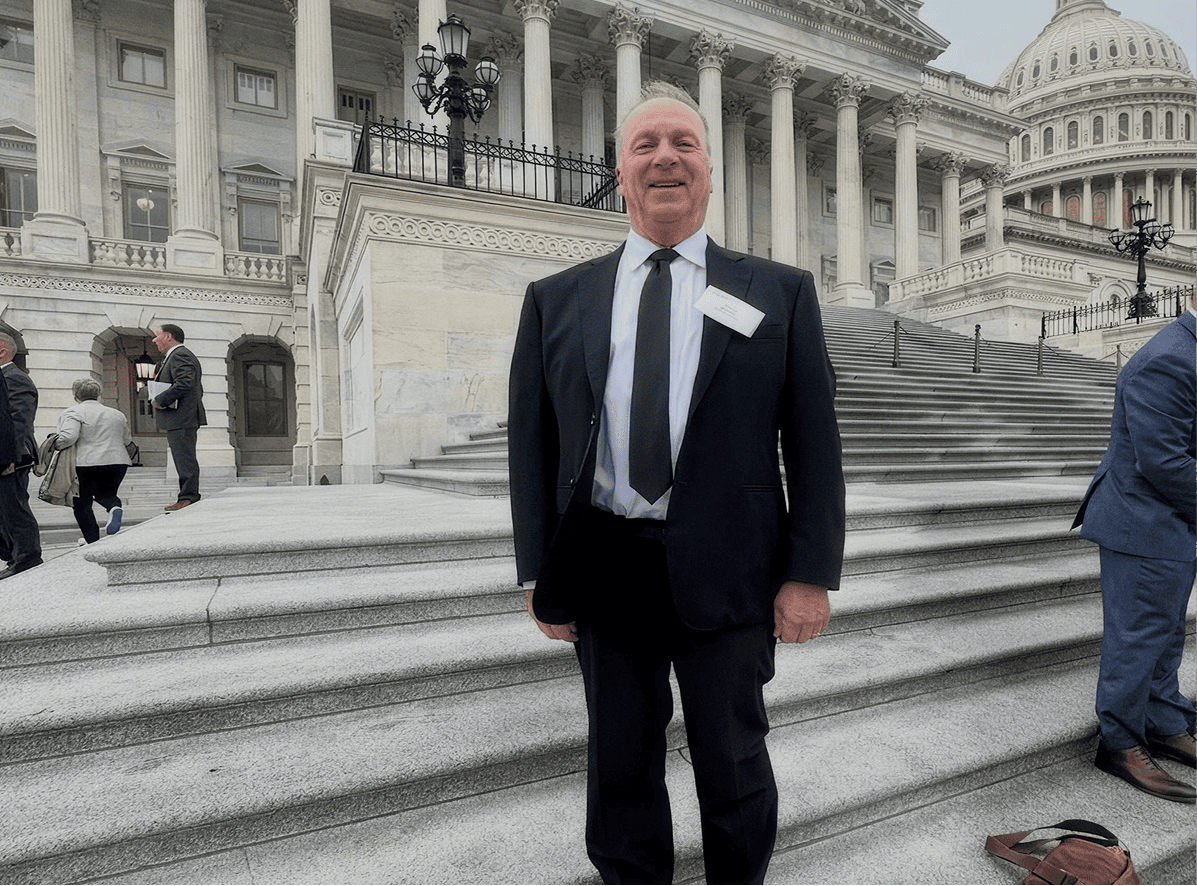
Before long, more than 100 claims had been filed against us, and the court rules provided little method to get them dismissed. Eventually, I found out that more than 20,000 US companies had similar lawsuits; it was a national crisis. Because I was willing to speak openly about the problem, President Bush invited me to speak with him on an hour-long panel discussion. The following year, I went to Washington DC with a group of manufacturers, where we met with fourteen senators over three days, asking for tort reform.
Eventually, there were lots of small reforms regarding asbestos litigation; our lawsuits were finally dismissed, and the problem went away.
One other piece of litigation that bothered me was when a big city had purchased a five-horsepower vertical air compressor and was using their employees to move it into a subway. Somehow the air compressor slipped off the forklift and fell on one of the workers, causing him a knee injury that required surgery. Of course, we got sued for a defective product, and after seven years the case was scheduled for trial.
The state law had a rule known as joint and several liability, which meant that if a manufacturer was even only one percent responsible for the injury, they might have to pay 100 percent of the damages. The party that should have been responsible was the city, but because they were exempted from liability under workers' compensation laws, our insurance company settled for $750,000.
Usually, when a company pays that kind of money, they did something wrong, and something needs to be fixed. To this day, I don’t know what we did wrong or what should be fixed.

Life-long Education and Self Improvement
I have always believed in lifelong education and invested a huge amount of time and money to continuously improve my skills. During my time with IBM, I learned many technical aspects of computing that included how to program in assembly language and integrating components of a computer system so that they worked more efficiently.
That background allowed me to continue with technology, using Excel and our ERP systems to monitor the performance of our business. Also, I’ve spent hours per week researching things on the Internet to learn more about our industry and enhance my skills. My wife was always irritated when I referred to my phone as a brain enhancer. I currently have paid premium subscriptions to LinkedIn, Seeking Alpha, Instant Checkmate, Microsoft Co-Pilot, Satellite Radio, YouTube, ChatGPT, and Investor Village.
Today I use the paid version of ChatGPT to improve my research, summarize lengthy materials, rewrite my articles & emails, review contracts, and provide advice on the various problems that come up in business. While I also vet AI answers with secondary sources, it has been a big time saver for me.
Trade associations have provided another important part of my continuing education. I have been actively involved with three industry associations and have sometimes attended as many as ten conferences in a year. These meetings provide access to speakers and experts addressing manufacturing, economics, taxation, government policy, safety, technical standards, and other matters relevant to our companies.
The associations also provide opportunities to work directly on industry standards and government regulations. Just as importantly, their meetings and receptions have allowed me to exchange ideas with other executives who face many of the same responsibilities and problems that I do. As technology developed, the trade associations started conducting phone and Zoom meetings that increased the frequency of our engagement.
Locally, I have participated for decades in a CEO peer network composed of business owners and senior executives. The group meets for two hours each month. These discussions provide a confidential setting in which participants can compare experiences and learn how other companies approach employees, customers, financing, succession, economic changes, and other management challenges.
Official Appointments
Association of Equipment Manufacturers:
Tax Policy Working Group Chairperson: 2017-2018
Government & Public Affairs Committee: 2024 to present
Compressed Air & Gas Institute
Reciprocating Air Compressor Section:
Chairperson 1998-1999 and 2014-2016
Portable Air Compressor Section:
Chairperson 2022-2024
Rotary Positive Air Compressor Section:
Chairperson 2024 to present
Member of Board of Directors
2018 to present
Our banks and insurance companies have also been valuable sources of education. They conduct conferences, webinars, and other programs covering economic conditions, employment practices, cybersecurity, legal developments, risk management, and insurance. Law and accounting firms also offer seminars that help us understand new requirements and reduce legal and financial risks.
I have also worked with a professional business coach who specializes in advising chief executives. A coach provides an independent perspective and can ask questions that employees, directors, or outside professionals may not ask. The value is not that the coach makes decisions for me, but that the process forces me to examine assumptions, establish priorities, and hold myself accountable for following through.
These different forms of education reinforce one another. Technical knowledge helps me understand manufacturing systems. Financial knowledge improves investment and pricing decisions. Industry relationships provide practical information that cannot always be found in reports. Peer groups and coaching challenge my assumptions.
Collectively, these activities have worked like a snowball, helping my skills get bigger and bigger as time rolls on.
What I Do at Work…
My work today is different from what it was when I first joined the business. I am no longer responsible for personally managing every daily activity. We have capable executives, managers, engineers, supervisors, and other employees who run their respective areas. My responsibility is to understand how the entire business is performing, make sure the different parts of the organization are working together, and become directly involved when an issue could materially affect the company.
A significant part of my time is spent monitoring the three business units and reviewing key performance indicators. I follow incoming orders, sales, backlog, production schedules, inventory, margins, expenses, cash flow, receivables, and commitments to suppliers. Because we operate two manufacturing plants with different products and operating characteristics, I need to understand not only the consolidated results but also what is occurring within each business unit.
I have always been comfortable working directly with computer systems and detailed business data. When I travel, I take my laptop and retain access to the ERP systems at both plants. I generally review the business results every day, regardless of where I am.
This access allows me to investigate questions quickly rather than waiting for someone else to prepare a special report. For example, I can examine open purchase orders by due date and estimate how much we will owe suppliers during a particular period. I can review customer orders and backlog, compare them with production schedules, and determine whether staffing, inventory, and expected demand are reasonably balanced.
Over the years, I have learned many of our products, customers, and part numbers. That detailed knowledge helps me identify excess or obsolete inventory, unusual purchasing patterns, margin problems, and products that may have been priced incorrectly. It also helps me recognize when something in a report simply does not make sense.
Finding a mistake is not primarily about assigning blame. In a business with thousands of parts, numerous product configurations, and many employees entering information, errors are inevitable. The important thing is to identify the cause, correct it, and improve the process. Otherwise, the same problem is less likely to occur again.
When I am at one of the plants, much of my time is spent meeting with employees. Some meetings involve only two or three people, while others may include 20 or more. Regular meetings include production and scheduling reviews, engineering and product-design reviews, warranty and quality discussions, safety meetings, sales reviews, financial reviews, and executive planning sessions.
I also have many less formal, one-on-one conversations with key employees, usually in their offices and often about an issue that has recently developed. These discussions help me obtain information directly from the people closest to the work. We also meet with important customers, distributors, suppliers, bankers, insurance representatives, and other business partners. Video conferences have become a routine part of the job, particularly because our two plants are located in different states, and our distributors and customers are located throughout the country.
Manufacturing also produces a steady flow of unexpected events. A machining center may break down. A supplier may fail to deliver an essential component. A large customer may change or cancel an order. An employee may be injured, a key person may leave, or a dissatisfied customer may ask to speak directly with the CEO. A product problem in the field may require engineering, manufacturing, purchasing, sales, and product-support personnel to work together immediately.
These events mean that an executive cannot completely control the daily schedule. However, I have learned that good planning makes the company better able to respond. Adequate inventory planning, preventive maintenance, trained employees, reliable information, and clearly assigned responsibilities do not eliminate surprises, but they reduce the disruption those surprises create.
Another important part of my job is deciding where the company should invest its money and management attention. Selecting a new machining center, developing a compressor, expanding a product line, changing an ERP system, or entering a market can require months of research. These decisions must consider customer demand, productivity, product quality, available personnel, financing, expected returns, and the long-term direction of the business.
Certain decisions continue to require my approval. These include major contracts, significant capital expenditures, important pricing changes, wage and benefit programs, borrowing arrangements, and other commitments that could materially affect the company. I do not believe these decisions should be considered in isolation. Pricing, for example, must reflect expected customer demand, production capacity, competitive conditions, material and labor costs, tariffs, and the margins required to support future investment.
One of my most important responsibilities is connecting these different considerations. A sales forecast affects the production schedule. The production schedule affects purchasing, inventory, staffing, and cash requirements. Changes in wages, steel prices, components, freight, insurance, interest rates, or tariffs affect product costs and pricing. A major decision in one area can have consequences throughout the organization.
The economic environment also changes continually. During my career, we have operated through recessions, inflation, large cost increases for employee health insurance, interest rate changes, steel shortages, the COVID pandemic, severe supply-chain disruptions, and major changes in tariffs and government policy. Some periods require additional hiring and investment. Others require price increases, spending reductions, reduced production schedules, or layoffs.
These are among the most difficult decisions a business owner makes. Price increases can strain customer and distributor relationships, while layoffs affect employees and their families. Nevertheless, management has a responsibility to make the adjustments necessary to protect the long-term financial health of the company. Avoiding a difficult decision may feel better temporarily, but it can create a much larger problem later.
Travel is still a big part of my job, and it is also one of the most satisfying parts. I attend about five industry-association meetings and approximately four to seven trade shows each year. I try to attend most of them because they provide direct contact with our distributors, customers, suppliers, and competitors. Trade shows are not simply sales events. They are valuable sources of market information.
At a trade show, I can hear what distributors are experiencing in their territories, see competing products, learn about new technologies, and identify changes in customer expectations. Many of our product developments and improvements have been influenced by information gathered through these conversations.
The bank and accounting firm are big parts of my engagement as there is constantly something new coming up. I supply them with monthly reports and attend their various social events, which can be anything from a reception to a breakfast meeting to a golf outing.
My job, therefore, is not limited to any one function. I move continually between detailed operating information and long-term strategy. On the same day, I might review backlog and margins, discuss a production problem, approve a contract, participate in an engineering review, speak with a distributor, and consider an investment that will affect the company for the next 10 or 20 years.
Ultimately, my responsibility is to make sure that the companies remain financially sound, operationally capable, and positioned to compete in the future. That requires knowing when to rely on the people responsible for an area, when to ask more questions, and when a decision is important enough that I need to become personally involved.
Even though I am well past the age of normal retirement, I have no plans to stop working soon. The business provides benefits to employees, suppliers, customers, and many other stakeholders. Meeting at the associations with other interesting people is always meaningful, and living through the age of new technology makes work exciting.